Entrepreneurship Reimagined: Launching Your Startup with AI as Your Co-Founder
An experiment using several AI models as startup collaborators across ideation, planning, pricing, prototyping, marketing, branding, and launch.
If you’re reading this, it’s likely that you’re eager to embark on a new venture that has the potential to disrupt the market or provide a consistent income stream. However, there’s often a wide gap between jotting down ideas on a slip of paper and turning them into a formal business plan—a gap that can feel daunting. That’s why, in this blog, I decided to tap into the power of several AI models, evaluating their ability from the ideation stage all the way through the growth strategy development of a business.
Below, you’ll see how each of these models can contribute to shaping a brand-new business. Imagine having a friendly mentor who knows the best strategies, asks the right questions, and lays out a clear path forward.
To design this business step by step, I posed a consistent set of questions to each AI model. These questions covered everything from brainstorming and drafting a business plan to pricing, marketing, and branding. By comparing their responses, I could gain a broad perspective on the best way to build this venture and discover which AI model excels at each stage.
Throughout this process, we’ll address topics like market research, pricing structures, digital marketing, and more. Ultimately, we focus on practical solutions you can start using right away on your own entrepreneurial journey. Imagine it as a friendly, casual conversation that is both engaging and in-depth, guiding you towards practical action steps for launching your startup.
Below is the list of questions I asked. Each one tackles a crucial aspect of business development, from ideation to final branding.
The AI Models I Used
- O1-Pro from OpenAI
- Claude AI from Anthropic
- Perplexity Pro from Perplexity
- Gemini Advanced from Google
- Deepk Seek from Deep Seek
The result of this conversation at a glance:
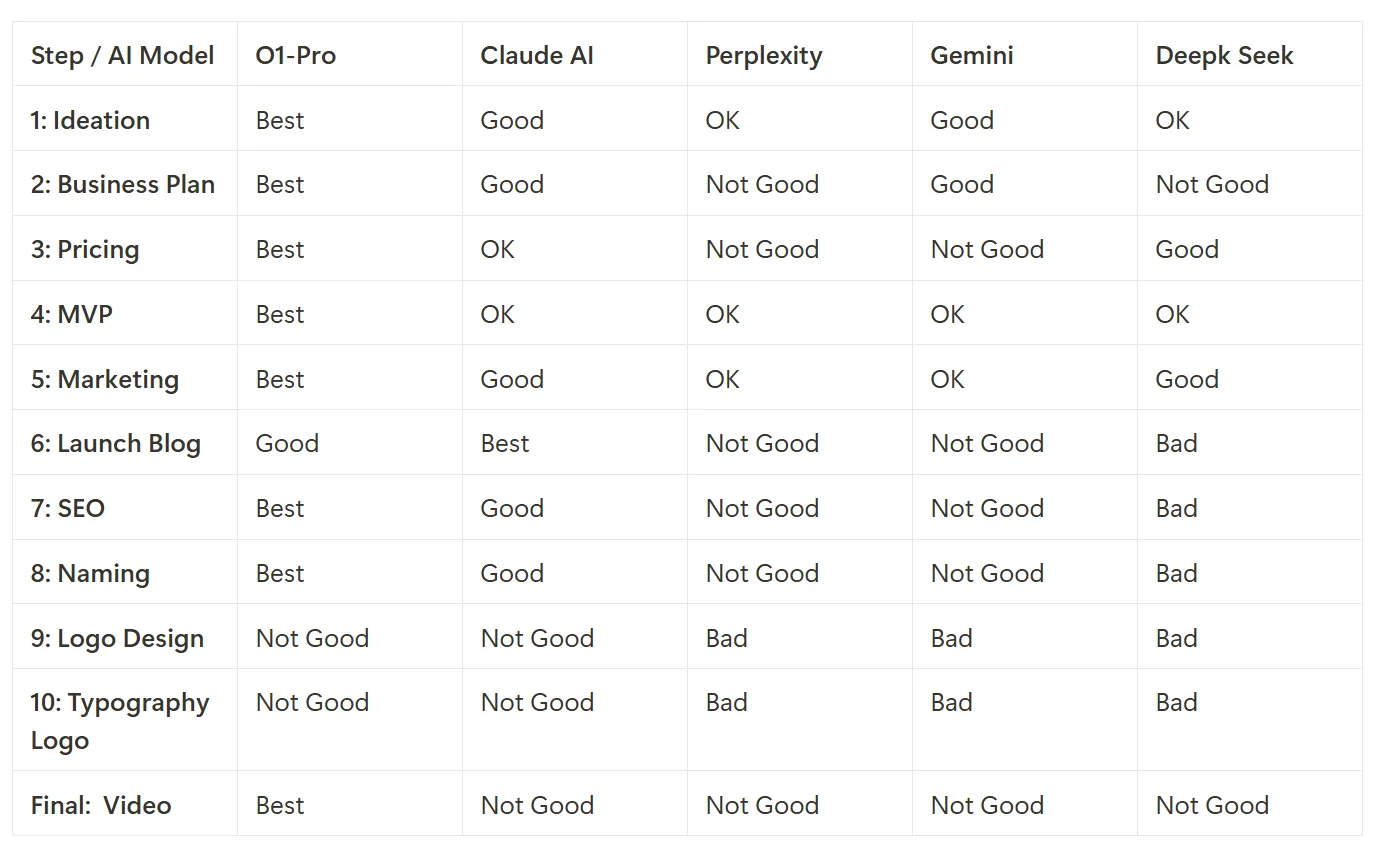
To see how each AI model performed at a glance, refer to the comparison table below. Each row represents a key step in building the business, and each column shows how effectively each AI handled that stage—rated as Best, Good, OK, Not Good, or Bad.
Step 1: Ideation
Why This Question Matters
Before diving into a formal business plan, I needed ideas that align with specific factors like market trends, economic indicators, and the founder’s location. By clarifying these parameters, I could filter out irrelevant suggestions and focus on concepts that truly matched our target audience, the founder’s skill set, and untapped market segments.
Professional Tip
Treat AI like a consultant rather than a simple Q&A machine. Ask it to generate follow-up questions about your goals, constraints, and preferences. This approach encourages deeper brainstorming and collaboration, leading to more tailored insights.
Question
I want to propose 10 business ideas considering the following factors:
- Current market trends
- Trump presidency
- Global economic indicators
- Feasible in the founder’s place of residence (United States or the Netherlands)
- Related to the founder’s job (software domain or product manager)
- Not an enterprise; must be a product offered to individual consumers, not companies
- The target audience is 20- to 40-year-olds
- The product should be gender-neutral
- Very few similar products in the market, indicating an untapped opportunity
Conclusion
After evaluating responses from various models, O1-Pro stood out by offering an innovative idea closely aligned with our criteria. It proposed a direction I hadn’t considered, matching our target market’s needs and suggesting a promising business model in an emerging area.
Step 2: Creating the Business Plan
Why This Question Matters
A business plan serves as the blueprint for your startup, covering everything from market analysis and financial forecasting to growth strategies and operational details. Many startups begin without one, only to scramble when they need funding. Drafting a plan early on and updating it as you learn about your market and customers can save both time and resources. When you eventually need it for investors or potential partners, you’ll already have a solid plan in place.
Question
Give a comprehensive business plan for the following startup idea:
A personalized skill-exchange platform.
- What it is: A mobile/online application where people connect to learn or exchange specific skills (e.g., cooking lessons in return for coding lessons)
- Why it works: The rise of the gig economy and peer-to-peer learning
- Founder fit: Requires software expertise for secure transactions and user matching algorithms
- Unique angle: Focus on community-driven skill exchanges rather than professional teaching
Conclusion
- O1-Pro and Gemini Advanced both presented detailed, logic-driven plans.
- O1-Pro’s plan stood out for its extensive reasoning and depth.
- Claude AI offered a solid financial analysis, highlighting costs and revenues over the first few years.
- Perplexity and Deepk Seek provided more high-level outlines without deep reasoning.
Overall, combining O1-Pro’s depth with Claude AI’s financial logic produced the best results at this stage.
Step 3: Pricing
Why This Question Matters
Pricing is often one of the biggest challenges for new ventures, especially in competitive markets. You need to consider both profitability and how your target audience perceives value. A thorough competitive analysis helps you see what others charge and why. Too high a price can scare customers away; too low can undercut your brand or lead to losses.
Professional Tip
Use AI as a consultant by prompting it to ask questions about costs, market positioning, competition, and profit margins. By answering these queries, you help the AI deliver a more insightful pricing strategy.
Question
For this personalized skill-exchange platform, what pricing strategy should be adopted in the Netherlands or the U.S., taking into account the pricing of any similar products if available?
Conclusion
- O1-Pro suggested multiple pricing models with competitive analysis.
- Claude AI was succinct but lacked deeper analysis.
- Perplexity and Gemini Advanced relied mostly on generalized internet data.
- Deep Seek R1 offered a concise but coherent pricing strategy; paired with O1-Pro’s framework, it forms a robust plan.
Step 4: Building the MVP
Why This Question Matters
A Minimum Viable Product (MVP) is a streamlined version of your offering that includes only the core features needed to test market viability. This applies whether it’s a software platform, a physical product, or a service. Validating assumptions early helps you gather feedback, refine your approach, and avoid overbuilding.
Professional Tip
Request more than just a list of technologies. Ask AI to detail practical steps like workflow design, user journey considerations, and potential risks. This gives you a well-rounded guide on both what to build and how to launch it effectively.
Question
Explain in practical detail how to build an MVP for this skill-exchange product, step by step. Focus on technical, operational, and user-experience aspects and how to launch it effectively.
Conclusion
Most models recommended software tools and platforms, but O1-Pro went further by laying out a detailed roadmap that delved into operational planning. As a result, O1-Pro was the most helpful choice for this phase.
Step 5: Marketing
Why This Question Matters
Even the most groundbreaking product can fail to gain traction without an effective marketing plan. A solid strategy ensures your target audience recognizes your offering’s value. By selecting the right channels, tools, and timelines, you can establish brand awareness and pave the way for sustainable growth.
Professional Tip
Rather than requesting general marketing advice, ask AI for a step-by-step plan with specific timelines and KPIs. This transforms generic tips into an actionable roadmap you can follow.
Question
What is the best marketing strategy, and which tools should I use to achieve our desired outcomes for this skill-exchange startup? Please provide a step-by-step plan, emphasizing task sequence.
Conclusion
- O1 Pro delivered a clear, sequential plan.
- Claude AI gave a decent outline but lacked depth in each component.
- Perplexity produced high-level, search-based results with little added analysis; Gemini Advanced offered a summary-like response.
- Deep Seek R1 stood out with a tentative timeline for each campaign phase.
Combining O1 Pro’s structured approach with Deep Seek R1’s scheduling can create a strong marketing roadmap.
Step 6: Crafting a Launch Blog Post
Why This Question Matters
A well-written blog post is crucial for introducing your product or service, projecting professionalism, and boosting SEO. I wanted to see how each AI model handled creative writing, coherence, and SEO optimization to effectively showcase our skill-exchange platform.
Question
Write a creative, high-quality blog post to launch our skill-exchange product. It should be SEO-friendly, clearly highlight benefits, and maintain an engaging tone with relevant keywords as needed.
Conclusion
- Perplexity offered an essay-like text lacking depth.
- Gemini Advanced struggled to understand the task and produced near-gibberish.
- Deep Seek R1 encountered errors and couldn’t respond.
- O1-Pro focused on comprehensive benefits but lacked a compelling narrative spark.
- Claude AI excelled at producing engaging content — even creating an imaginary success story.
In this round, Claude AI took the lead for its storytelling flair and lower cost.
Step 7: SEO
Why This Question Matters
In today’s digital age, SEO serves as the fuel for businesses of all sizes. Without proper optimization for websites, social media, or other online content, you remain virtually invisible to potential customers. I wanted to see which AI could deliver an SEO strategy capable of boosting a skill-exchange platform to higher search rankings.
Professional Tip
Don’t focus solely on keyword lists. Ask the AI for a plan that covers technical, on-page, and off-page SEO, along with suggested timelines or priorities. This helps turn generic advice into a concrete plan tailored to your goals.
Question
What SEO strategy do I need for our skill-exchange platform so that our online content—website, social media, etc.—ranks high enough to attract customers?
Conclusion
- O1 Pro provided a clear, user-friendly SEO plan.
- Claude AI offered a detailed approach but included overly technical points that lacked sufficient explanation for non-experts.
- Google and Perplexity gave high-level tips resembling rehashed blog content.
- Deep Seek encountered errors.
Here, O1 Pro was the best option for its accessible, comprehensive strategy.
Step 8: Naming
Why This Question Matters
Naming a startup goes beyond just being creative; it influences brand perception and memorability. Many founders spend months—or hire agencies at significant cost—to find a name that resonates. A 2018 study by Clutch revealed naming services can range from $3,000 to $75,000, illustrating the importance of this decision.
Professional Tip
When using AI for naming, have it ask clarifying questions about your brand’s values, target audience, and long-term vision. This ensures the final name aligns with your brand strategy rather than just sounding catchy.
Question
Help me brainstorm potential names for our skill-exchange business. Consider the brand vision, a 20-to-40-year-old audience, and appeal in both English- and Farsi-speaking markets.
Conclusion
- Most models suggested similar or generic names.
- O1 Pro stood out by proposing “Maharatoo,” modern and culturally relevant for a Farsi-oriented brand. The English translation of such name would be “Skillio.”
- Claude AI offered creative options but with less cultural alignment.
- Perplexity and Gemini Advanced mirrored typical internet lists.
- Deep Seek R1 failed to provide meaningful ideas.
O1 Pro’s “Maharatoo” was the clear winner for its contemporary feel and cultural suitability.
Step 9: Logo Design
Why This Question Matters
A logo is more than a visual mark—it’s often the first impression customers have of your brand. A well-designed logo reflects your company’s values, personality, and professionalism in an instant. While AI can offer quick concepts or color suggestions, creating a truly memorable design often requires the human touch, especially for refining more abstract ideas into a cohesive brand identity.
Using AI Models for Logo Design
- Benefits:
- Rapid brainstorming for styles and concepts
- Automated suggestions for color palettes and layouts
- Low-cost way to generate initial ideas
- Limitations:
- Difficulty capturing nuanced brand identity or cultural factors
- Limited artistic refinement, often lacking originality
- Generic designs that require extensive human revision
Question
For this business named ‘Maharatoo,’ please design a logo that embodies a skill-exchange platform, is modern and appealing, and suits a Farsi-speaking market.
Conclusion
None of the AI models generated genuinely satisfying outputs. O1 Pro provided more detail, and Claude AI tried an SVG-based concept, but neither was fully suitable for professional branding. Perplexity and Gemini Advanced produced generic, repetitive designs, and Deep Seek encountered errors. Professional designers or marketing agencies remain the better option for crafting a standout logo.
Step 10: Typography Logo
Why This Question Matters
Typography logos (wordmarks) rely solely on stylized text. Though seemingly simpler, they still demand careful consideration of font selection, spacing, and alignment. I wanted to see if the AI models could handle these nuances.
Question
Now convert the logo to a typographic design and provide it.
Even with this straightforward request, I hoped the models would suggest unique fonts, spacing, and styling for “Maharatoo”.
Conclusion
Despite the seemingly easier nature of wordmark logos, no AI model delivered a visually compelling result. Most outputs were generic or confusing, suggesting that while AI can help with brainstorming, finalizing a polished typography logo still benefits greatly from professional human designers.
Final Step: Creating a Launch Video with Sora
Why This Question Matters
AI can now generate more than just text or images—platforms like Sora (an OpenAI product) can create entire videos. Though it’s currently expensive, the potential is enormous. The idea of using one AI (O1 Pro) to produce prompts for another AI (Sora) feels like a loop of innovation, with humans overseeing the final output. It hints at the future of content creation, where machine collaboration saves time, sparks creativity, and extends a brand’s reach.
Question
GPT O1 Pro
Give me a prompt for a 20-second video for an AI model that creates a launch video:
- A personalized skill-exchange platform
- What it is: A mobile/online application that connects people to learn or exchange skills (e.g., cooking lessons in return for coding lessons)
- Why it works: The rise of the gig economy and preference for peer-to-peer learning
- Founder fit: Requires software expertise for matching algorithms and secure transactions
- Unique angle: Focus on community-based skill exchanges instead of professional teaching
Conclusion
By having O1 Pro craft a video script for Sora, I witnessed AI guiding another AI, with humans supervising to shape the outcome. It’s both thrilling and a bit surreal, offering a glimpse of how inter-AI collaboration may evolve. For now, though, it’s a powerful tool that saves time, unleashes creativity, and could redefine how I produce and share promotional videos.
Final Word
After testing multiple AI models across various stages of creating and growing a startup—from ideation and business planning to pricing, MVP development, marketing, SEO, naming, and logo design—one thing became clear: every model has its own strengths and weaknesses. OpenAI O1-Pro stood out for its comprehensive reasoning and consistently helpful insights, making it a robust choice for entrepreneurs who need in-depth guidance. Claude AI also performed well in several tasks and, given its lower cost, offers a cost-effective solution with surprisingly strong content generation abilities.
By contrast, Gemini Advanced and Perplexity tended to rephrase existing web content rather than providing truly original or insightful answers. They had their moments of usefulness but often fell short when more detailed reasoning was required. Deep Seek, though it delivered standout results in some instances, struggled with scalability under heavier loads and showed limitations when interacting in languages other than English. Nonetheless, its innovative approach indicates strong potential—especially if you primarily communicate in English and can handle occasional service interruptions.
Ultimately, a hybrid approach may be the most effective approach, utilizing tools such as O1-Pro or Claude AI for complex and strategic questions and utilizing simpler tools like Gemini Advanced or Perplexity for quick reference. If you’re an entrepreneur seeking AI-driven support, take into account the unique strengths and limitations of each platform, and feel free to combine them as necessary to optimize efficiency.