Vibe Coding: The Game I Didn’t Know That I’m Playing
A personal look at why AI-assisted coding feels so compelling, through variable rewards, flow, and the game mechanics hidden inside every prompt.
I still remember the first time I typed “ChatGPT” into my browser, it was January 2nd of 2023, almost a month and half late into the game since its release in November 2022, and saw that little box sitting in the middle of the screen. It was a dark and rainy night, the storm hitting the window like the world was ending. (I just watched a horror movie before sitting down to write this, so I think I’m still a little under the influence.) I opened this magic box, typed “hi, how’re you,” and like Alice slipping through the root of the old tree into Wonderland, I got pulled in. Not physically, obviously, but my second brain, maybe the better of the two, lives in there now. I’m basically Theodore Twombly from Her.
At first I told myself I was just experimenting. That lasted about thirty minutes, which is roughly how long it takes to realize this is not a fancy search bar. It’s something stranger, a kind of intelligence trapped in silicon. In some aspects we living things are still smarter than it, and in others it’s already well ahead of us, so it’s the first thing we’ve built with our own hands that could one day take the steering wheel and tell us, “good 300,000-year ride, pal, now sit aside, this is my time.” And no, don’t get me wrong, I’m not trying to be a conspiracy theorist, but I’ve read enough Sci-fi from a hundred years ago quietly come true, and watched enough of the recent fiction movies, to recognize the signs when they show up in real life.
Soon I was using it for writing, and boy, it was like being Shakespeare in the body of a nerd with no feathered hat. Ask it to write a scene like Hamlet, except this time he doesn’t die, he grows old and ends up killing his daughter’s lover, and you’d have it in two minutes. You don’t look at Shakespeare quite the same way after that.
Fast forward past a semester of MBA homework I may not have finished entirely on my own (wink wink), and I’d started using AI to build websites, under my digital marketing course influence. I should admit I’m old school. When I started I was writing code in ChatGPT and pasting it into Notepad++ like a neanderthal, until I figured out what an IDE even was. You’d think a guy who once hand-wrote assembly for a calculator, on paper, for an undergrad exam would have known to open a real IDE on day one, but that same guy was happily copy-pasting into Notepad++ (don’t look at me like that, things were different back then, and it was still a huge upgrade).
I never thought of myself as a real developer. I was a WordPress guy, the kind who runs into some obscure problem where the only answer that ever existed was a single comment left by one stranger in a subreddit that got archived a decade ago and stopped taking replies, so there’s nobody left to even ask, and yet the box just knew the answer anyway. So I put up my personal site and a couple of others, and once I started writing on them I kept running into the same wall, where a passage would run too long and I could feel it would read better shaped some other way, except none of the blogging tools let you format text the way you actually see it in your head. So I figured I’d find out whether this genius was mature enough to hand me a bit of simple code, and I typed “give me a page where I can build HTML pages with Markdown,” and that turned out to be the first real hit of the dopamine that’s been rewiring my brain to prompt agents ever since. (That little builder still works, if you want to see what my first hit looked like: htmlblogmaker.)
And I could not put it down, not for a single day. I had and still have a full-time job, often a more-than-full-time one, and I was building on top of all of it after hours, carving the hours out of my family, my evenings, my weekends, almost every holiday, and, believe it or not, the occasional flight for vacations where the wifi could barely load a Google search. I built in every one of those times and places, like a forty-niner sure the gold was one more swing into the rock, until one day I stopped and asked the obvious question: why couldn’t I get off this thing?
The answer came from somewhere I hadn’t looked at in years. I remembered being a kid, my dad handing me my first console, a SEGA, and playing FIFA 94 like a pocket-sized Maradona with that little rush in my blood every time I scored, and the afternoons I lost chasing Nazis through Return to Castle Wolfenstein, six or seven hours at a stretch with my fingers swollen and blistered and tears running down my face because I’d forgotten to blink, like I was sitting in front of ten pounds of raw onion. I had shut that whole chapter of my life years ago and never once thought to reopen it, which is exactly why it caught me off guard to be sitting at my keyboard as a grown adult and realize that this glowing box was doing the very same thing to my brain that the console had done twenty years before.
So I went down the rabbit hole to understand why, and here’s what I found.
It’s the same machine, just with a better PR team
“Vibe coding” is what Andrej Karpathy, an OpenAI cofounder, named in early 2025: AI-driven building where you fully give in to the vibes and stop reading the code (Collins made it its 2025 word of the year; Merriam-Webster chose “slop”). It sounds like something new, but it isn’t. It’s a fresh wrapper around the exact reward pattern game designers have spent thirty years engineering into video games, and it long ago stopped being about code, because any job with an agent bolted onto it has inherited the same loop, whether you’re writing campaigns, drafting emails, or cleaning up a spreadsheet you only meant to glance at. The mechanics aren’t similar to gaming, they are gaming, and the only genuinely new part is the marketing.
Three things make a game impossible to put down, and all three were worked out long before any of us were prompting anything.
The first is the variable reward. The behaviorist B.F. Skinner showed back in the 1950s that the way to keep something pressing a lever isn’t to reward every press, it’s to reward it on a schedule it can’t predict. That’s the engine inside every slot machine, every loot box, every rare drop, and the dopamine doesn’t even peak when you win, it peaks in the half-second before, when you don’t yet know whether you will. Neuroscientist Wolfram Schultz and his coauthors observed dopamine responses shifting from the reward itself to the signal predicting it. The proof is almost insulting: nobody keeps feeding a broken vending machine, you quit after a try or two, but people will feed a broken slot machine for hours, because they never expected every pull to pay anyway. Now watch yourself with an agent. You write a prompt, you hit enter, and you have no idea what’s coming back, and sometimes it’s perfect, sometimes it’s garbage, sometimes it’s better than anything you’d have thought of sober. Every prompt is a slot pull, my FIFA 94 all over again, except the goals come every ninety seconds and I get to call it work.
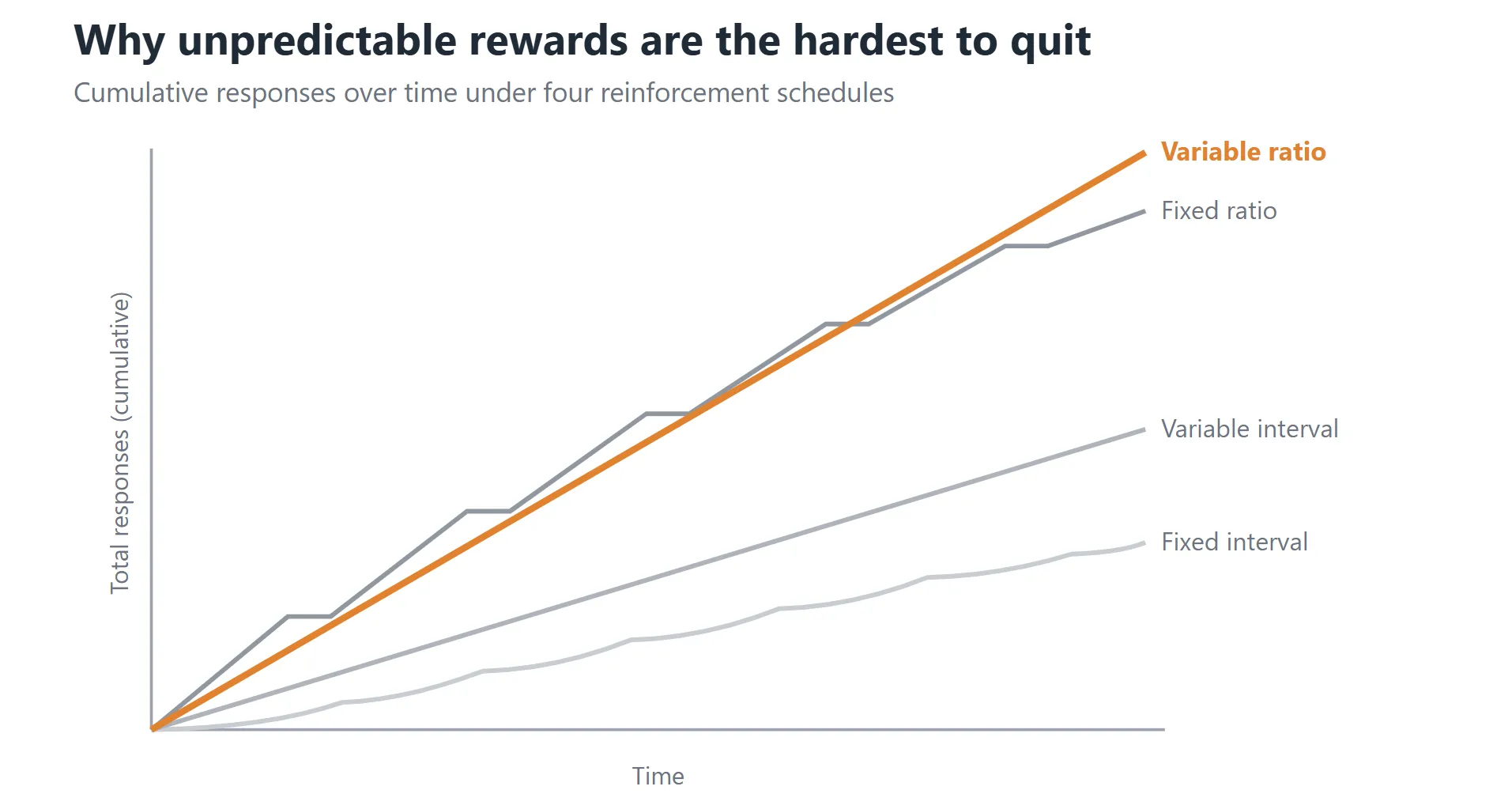
A variable-ratio payout (a reward after an unpredictable number of actions) drives the steepest, steadiest, most persistent response of the four. It is the engine behind slot machines, loot boxes, and hitting enter on a prompt
The second is a bundle of cravings, the three that researchers who study what makes games so hard to put down keep landing on: that you chose this and nobody’s making you, that you’re getting better and can feel it, and that other people can see you doing it. Agents serve up every one of them, hot. The autonomy is the one that got me, because for years the syntax had been a wall between me and the idea, and now I could just describe the thing in plain English and watch it run. (Again: the guy who wrote assembly on paper.) The competence comes just as fast, because instead of earning skill in slow drips over years you ship something your own hands couldn’t have made an hour ago, and your brain never stops to ask whether you earned it, it just lights up. And the recognition is right there in the commit counts and the endless “I built this in four hours” posts, the same high score we were always chasing, the same little hit of being seen.
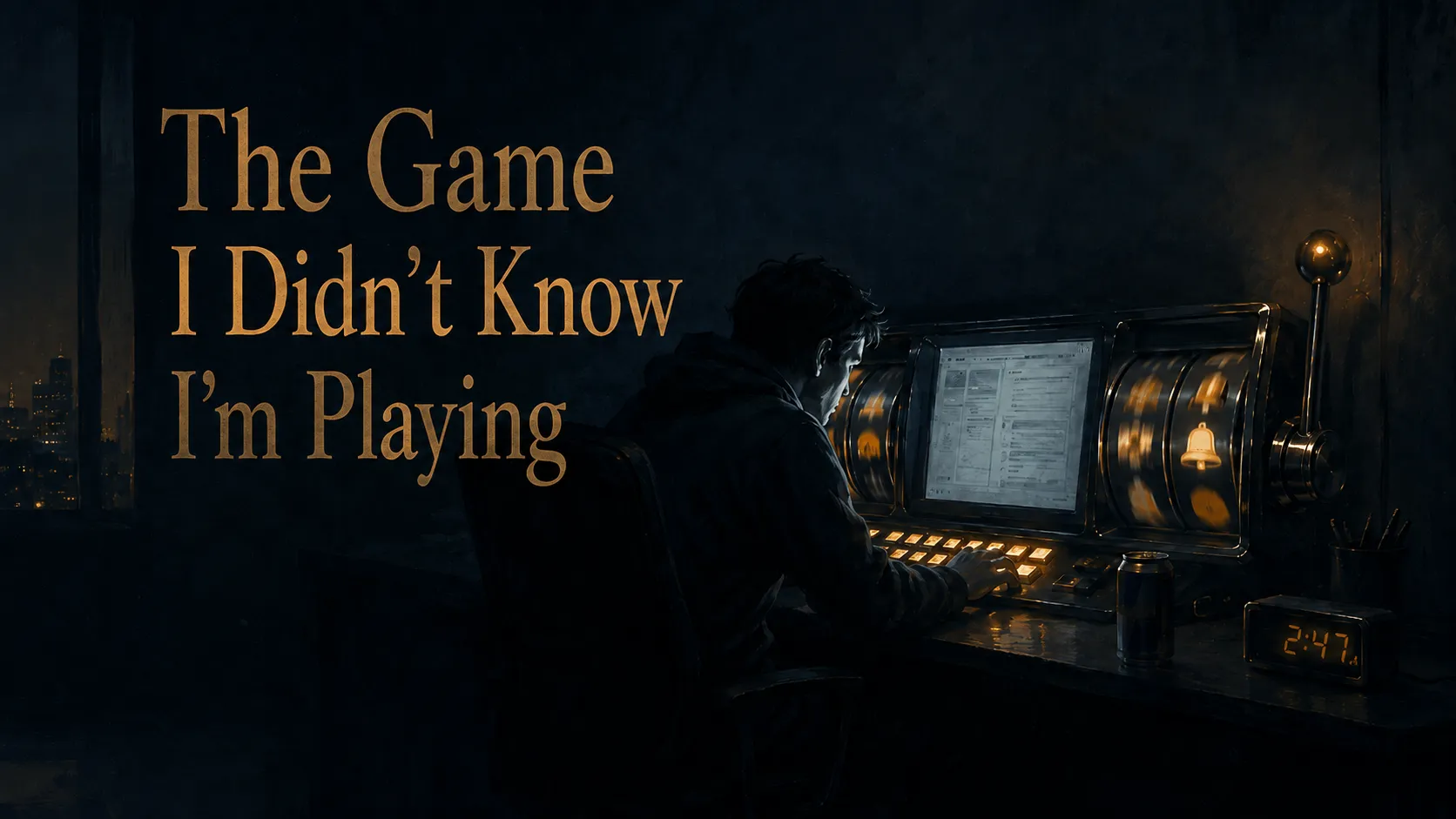
The third is flow, the word the psychologist Mihály Csíkszentmihályi coined for the state where challenge and skill lock into a loop tight enough that time disappears, your body disappears, the room disappears. It is the same trance that Natasha Dow Schüll, an anthropologist who spent years inside Vegas casinos, calls the machine zone. Games are built to drop you there on purpose, and so are agents, except the loop is even tighter, prompt, watch, accept, prompt, watch, accept, with no debugging stall, no hour lost in the docs, almost no gap between wanting a thing and seeing it exist. That’s how it gets to be 2:47 AM without you noticing, which, for the record, is roughly the time I’m writing this sentence.
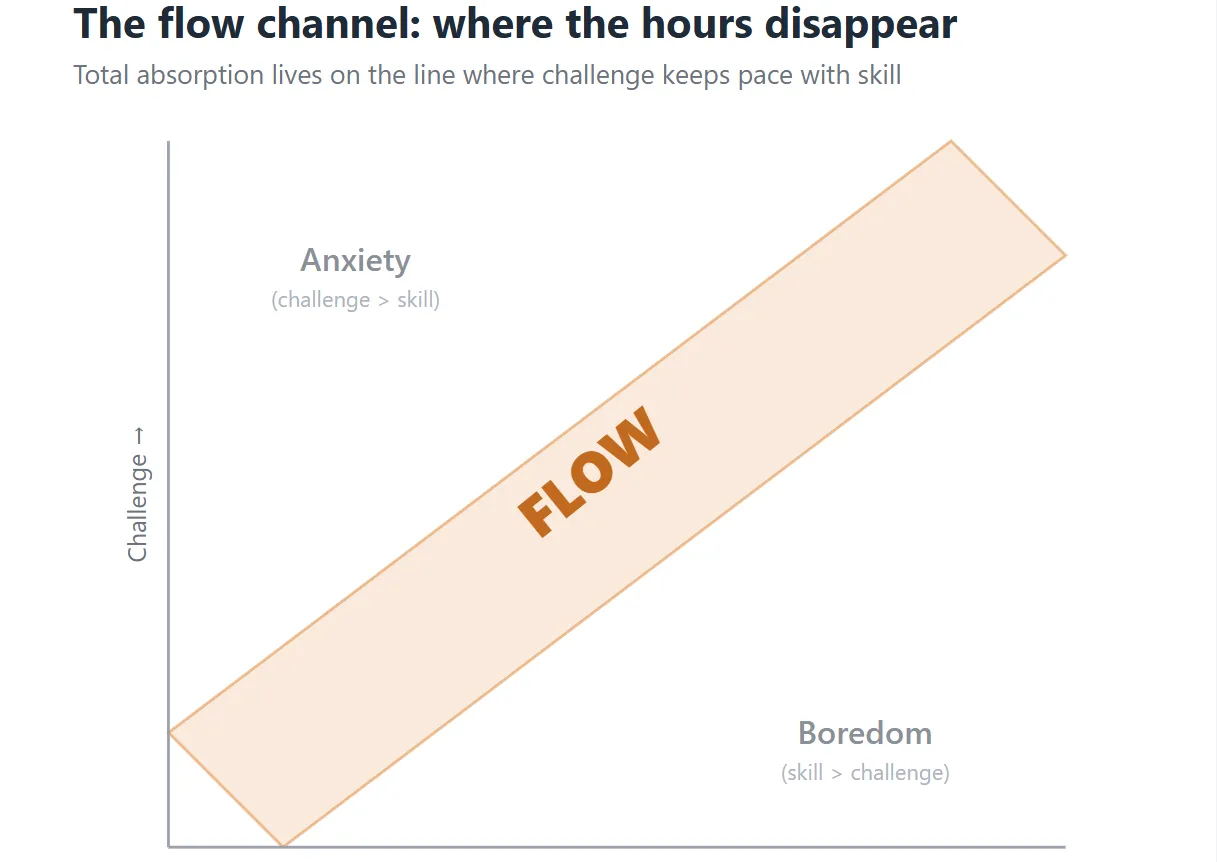
Csikszentmihalyi’s model: too much challenge for your skill tips you into anxiety, too little into boredom. An agent keeps nudging the difficulty so you stay in the channel, prompt after prompt, which is part of why time vanishes.
And none of it is an accident. The progress bars on long prompts, the token counters ticking up like a score, the streaks, the “apps shipped today” leaderboards, these are the same hooks that make every mobile game and fitness app so hard to close, and the people building these tools know the playbook cold, which isn’t a knock on them, it is just worth saying out loud, because the patterns that used to live in the apps we open to unwind now live in the tools we open to work.
How to tell you’re in the loop, not in the work
The cruel part is that from the inside it feels exactly like productivity. The dopamine fires, things appear on the screen, the session feels generative, and that is the machine doing precisely what it was built to do.
So here are the signs I’ve had to learn to catch in myself. You can’t say in one sentence what “done” looks like for the session you’re in right now. The last three prompts have just been polishing something that was already good enough two iterations ago. You’ve stopped actually reading what comes back before you accept it. And your body sent a signal an hour ago, the eyes, the neck, the ache in the back, and you waved it off, the onion-tears thing all over again, except now I’m twenty years older and supposedly know better.
Hit two of those at once and you’re not building anymore, you’re just spinning the loop, which is fine for an evening here and there but a real problem over a month, because those hours don’t compound into anything.
So I borrowed a guardrail for each of those, from people who actually study problem gaming, and they’re almost embarrassingly simple. Put the session on a clock, and when it rings, stop, not “after this one prompt” but now, because an external signal is the only thing that reliably breaks the loop before the next pull. Decide what “done” looks like before you open the tool, because a scoped goal turns the loop back into work while an open one turns it into play. And ship the thing to a real person fast, because nothing recalibrates your sense of whether it’s any good like watching someone actually use it.
In the end the difference between a builder and a player was never the tool, it is whether you can put it down when the session is over, and I’m still working on that one. It is 2:47 AM as I finish this, which probably makes the point better than I just did.