How Much Life Does a 45‑Minute Run Per Week Buy You?
A curious runner uses public-health guidance and a simple model to estimate what a weekly 45-minute run might mean for longevity and daily well-being.

I’m not a doctor, or a mathematician, or anything close. I’m just someone with a relentlessly curious brain. I picked up running only in the last couple of years, late by runner-internet standards, but it’s been oddly calming. It scrubs the mind, resets the mood, and lets you see the same life from a slightly different angle.
If you’re like me, juggling work, family and a growing list of reasons to skip today’s workout, adding numbers to the end of your life feels both morbid and deeply motivating. I’ve always wanted a friendly mentor who whispers, “this mile is worth X minutes of freedom.” So I did what any nerd with a heart would do: I put running into an equation.
Running
The Two‑for‑One Rule: Making Minutes Comparable
Public‑health guidelines say adults can meet aerobic goals with either 150 minutes of moderate or 75 minutes of vigorous activity per week. In other words, 1 minute of vigorous exercise counts as 2 minutes of moderate (CDC). Running hard falls on the vigorous end; a gentle jog is moderate.
To compare apples to apples, we’ll convert any workout into moderate‑equivalent minutes (ME). A 45‑minute jog equals 45 ME. A 45‑minute run — because it counts double — becomes 90 ME.
How Exercise Adds Years: A Curvy Relationship
A huge pooled analysis involving over 650,000 adults looked at how leisure‑time activity and life expectancy relate. Even low levels of activity, up to 75 minutes of brisk walking per week, were associated with about 1.8 years of additional life compared with doing nothing (Leisure time physical activity of moderate to vigorous intensity and mortality: a large pooled cohort analysis). Meeting the recommended 150–299 minutes per week correlated with about 3.4 years, and doubling that (300–449 min/wk) pushed gains toward 4.2 years. The gains flatten out as you add more.
When plotted, the curve climbs quickly at first and then levels off, more is better, but each extra hour yields less than the previous one. This shape inspired my longevity equation.
The Nerdy Equation
Here’s the rough recipe:
- Convert your workout to ME minutes using the two‑for‑one rule.
- Plug it into a longevity curve. I used a saturating function calibrated to the study above, so that the predicted years gained match 1.8, 3.4 and 4.2 at the appropriate weekly volumes.
- Calculate the difference. Compare your current weekly activity to your current plus one 45‑minute run. That difference, spread over the number of sessions you plan to repeat, gives the minutes of life “earned” per run.
In equation form, if you currently do W0 ME minutes per week and you add M ME minutes once weekly for T years, the long‑term life gain is ΔL=L(W0+M)−L(W0). Dividing by (52×T) converts that life gain into minutes per session.
The Long‑Run View (40‑Year Habit)
Let’s assume you’re starting from sedentary, you adopt a 45‑minute workout every week for forty years, and you stick with the intensity:
- Moderate 45‑min jog (45 ME): The longevity curve predicts ~0.97 years of life gained from this weekly habit. Spread across 40 years, each jog is worth about 244 minutes of life (roughly 4.1 hours).
- Vigorous 45‑min run (90 ME): The gain jumps to ~2.19 years. Per session that’s about 554 minutes (over 9 hours) of life.
These per‑session credits remain constant regardless of how long you keep the habit; what changes is the total life gained. Over forty years, the jog adds about 0.97 years and the run about 2.19 years, gains that mirror the 3.4- and 4.2-year plateaus from the pooled analysis (Leisure time physical activity of moderate to vigorous intensity and mortality: a large pooled cohort analysis).
The Short‑Run Experiment (One Year)
But what if you’re not ready to pledge decades? What happens if you run every week for just one year?
The per‑session life credit stays the same (244 minutes for a jog, 554 for a run) because the equation simply divides the total benefit by the number of sessions. What shrinks dramatically is the total time earned, since you’re only accruing benefits for 52 workouts:
- Weekly jog for a year: total life gain ≈ 0.024 years (about 8.9 days), or ~12 800 minutes across the year.
- Weekly run for a year: total life gain ≈ 0.055 years (about 20 days), or ~28 800 minutes across the year.
Those numbers sound modest, but remember that they’re cumulative. Stack enough runs and they compound.
Beyond the Math: Immediate Perks You Can’t See
Longevity isn’t the only benefit. Physiologists have shown that a single bout of exercise makes muscle cells more sensitive to insulin for up to 72 hours, improving blood‑sugar control even before any weight loss occurs. Meta‑analyses of blood‑pressure studies report that a single workout can lower ambulatory systolic pressure by about 3.2 mmHg and diastolic by 1.8 mmHg over the next 24 hours, with the biggest drop in the first few hours. In other words, each run is a tiny reset button for your metabolism and arteries.
Quick Reference
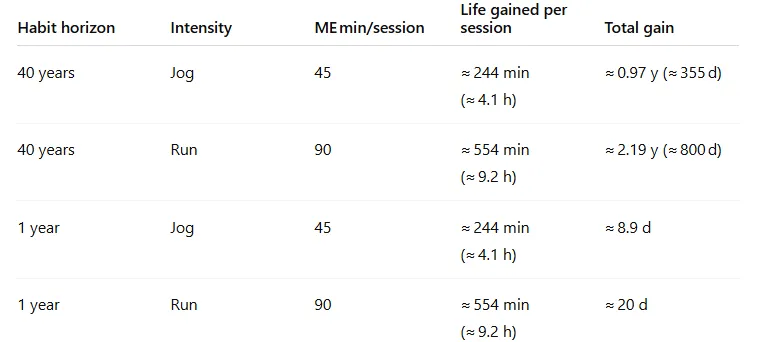
Quick reference of life increase when you run
Numbers assume you start from zero weekly activity and perform the 45‑minute session once per week.
Putting It Into Perspective
Of course, life isn’t an accounting ledger. These numbers come from large observational studies — they reflect associations, not a guarantee. Your genetics, diet, sleep and luck still matter. But when the costs are just sneakers and a chunk of your lunch break, the return on investment is astonishing.
Running may not make you immortal, but it will make you feel more alive. Even if you stop after a year, you’ll have spent 45 minutes a week exploring your neighborhood, sweating out stress, and collecting tiny time bonuses for your future self.
The fine print (protect-my-bottom disclaimer)
This is a personal, back-of-the-envelope experiment that stitches together published cohort results and a simple curve-fit. It’s not medical advice, and it shouldn’t guide your treatment, training, or risk decisions.
P.S. let me address the elephant in the room, yes, I used AI for the calculation and crafting the content, but the idea and many parts of the content are original out of my brain. And don’t forget to try KindnessSender.com.